
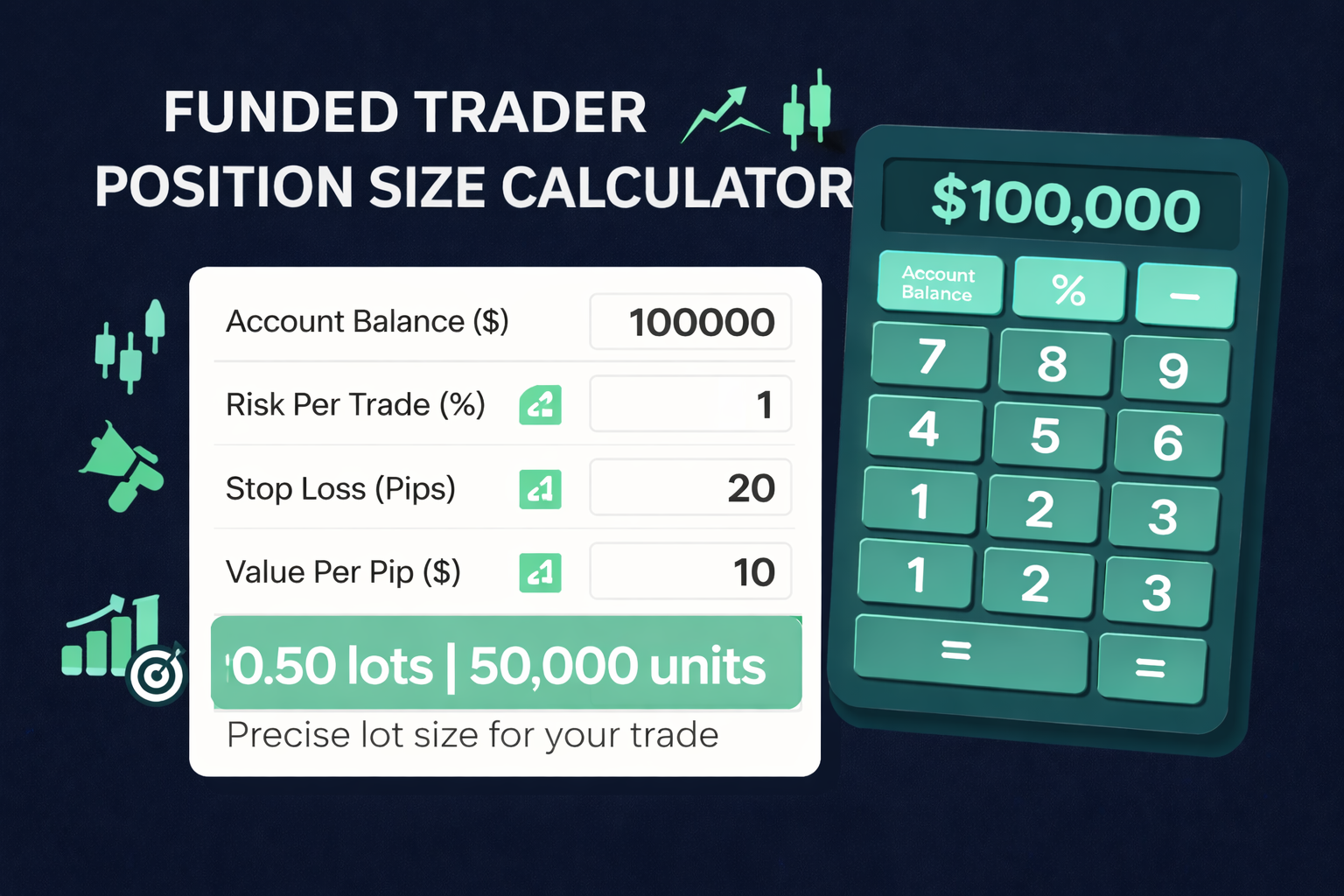
Position sizing isn’t just another trading calculation; it’s the math that determines whether you survive long enough to become profitable. You can have perfect entries, but if you’re trading 2 lots when you should be trading 0.5, one bad streak ends your funded account.
That’s exactly where the funded trader position size calculator comes in.
Instead of guessing lot sizes or doing mental math under pressure, the calculator instantly converts your risk per trade into the exact lot size your funded account rules allow.
You input your account size, risk percentage, stop-loss distance, and instrument, and within seconds, you know precisely how much to trade.
Why Position Sizing Kills More Funded Accounts Than Bad Entries
Here's what nobody tells you when you start trading with prop firm capital: your win rate matters less than your position size. You could win 60% of your trades and still blow your account if you're overleveraging on the losers. The numbers don't lie:
- Risking 5% per trade: You can survive 2 losing trades before hitting max drawdown (assuming a 10% max drawdown)
- Risking 2% per trade: Your account survives around 5 consecutive losses before reaching max drawdown
- Risking 1% per trade: You have roughly 10 losing trades before hitting critical drawdown levels
- Risking 5% per trade: You can survive about 14 consecutive losses before hitting max drawdown
- Risking 2% per trade: Your account survives roughly 35 consecutive losses
- Risking 1% per trade: You get 69 attempts before reaching critical levels
The difference between 1% and 5% risk isn't just 4 percentage points; it's the difference between having room to learn from mistakes and getting your account terminated after one volatile week.
The difference between risking 1% and 5% isn’t just position size; it’s how much margin for error you give yourself. Lower risk allows traders to absorb normal losing streaks, stay emotionally stable, and survive long enough to improve execution.
Most traders who fail their prop firm evaluations don't fail because they can't read charts; they fail because they sized positions based on confidence instead of mathematics.
The second mistake traders make is mental math. You think you're risking $100 on a 20-pip stop, so you calculate lot size in your head and move on.
But you forgot to factor in the actual pip value for your contract size. Or you miscalculated the conversion rate. Or you didn't account for the spread widening during news events. These "small" errors compound into account-ending mistakes.
Position sizing calculators exist because precision matters. When you're trading someone else's capital under strict drawdown rules, there's zero tolerance for approximation. You either calculate it correctly every single time, or you're out.
How to Use the Position Size Calculator (Step-by-Step)
Getting accurate results takes less than 60 seconds when you know which numbers to input. Here's exactly how to use our calculator for any trade setup:
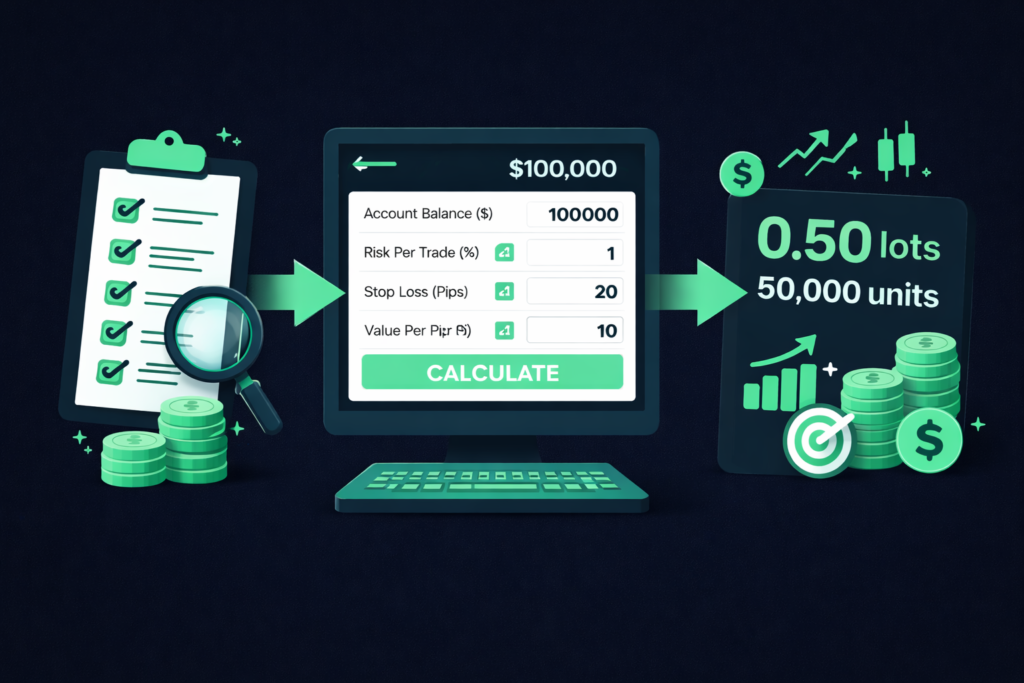
Input Your Core Trading Variables
Account Balance: Enter your current account size in dollars. For instant funding programs, this is your starting balance. For challenge accounts, use your current equity if you've already taken trades.
Risk Per Trade: This is where discipline separates profitable traders from blown accounts. You can input this as either:
- Percentage (recommended): Most professional traders risk 0.5% to 2% per trade
- Dollar amount: Use this if you have a fixed risk budget per position
For swing traders using programs like Pulse Flex, staying at the lower end (0.5-1%) gives you more breathing room for overnight volatility.
Stop Loss Distance: Enter the number of pips or points from your entry to your stop loss. Don't round this; use the exact distance your trading plan requires. A 19.5 pip stop is different from a 20 pip stop when you're calculating precise position sizes.
Pip/Point Value: This is the dollar amount per pip for one standard lot. For most forex pairs, this is $10 per pip per lot. Check your platform's contract specifications if you're trading indices, gold, or crypto. Getting this number wrong throws off your entire calculation.
Daily Loss Limit (Optional): If your prop firm has daily drawdown rules, enter your limit here. The calculator will show you how many similar trades you can take before approaching your daily threshold.
Understanding Your Results
Once you hit calculate, you'll see three critical outputs:
Recommended Position Size: This shows your lot size (primary) and units (secondary). The lot size is what you'll actually enter into your trading platform. For FX traders, units are calculated using the standard lot convention (100,000 units = 1 lot).
Dollar Risk at Stop Loss: This confirms exactly how much you're putting at risk if price hits your stop. This number should match your intended risk amount; if it doesn't, something in your inputs needs adjustment.
Daily Loss Safety (if applicable): When you enter a daily loss limit, the calculator shows what percentage of your daily allowance this single trade consumes, plus an estimate of how many similar losses would trigger a breach.
Common Position Sizing Mistakes That Blow Funded Accounts
After watching thousands of traders navigate prop firm challenges, we've identified the recurring calculation errors that consistently destroy accounts. Avoid these patterns:
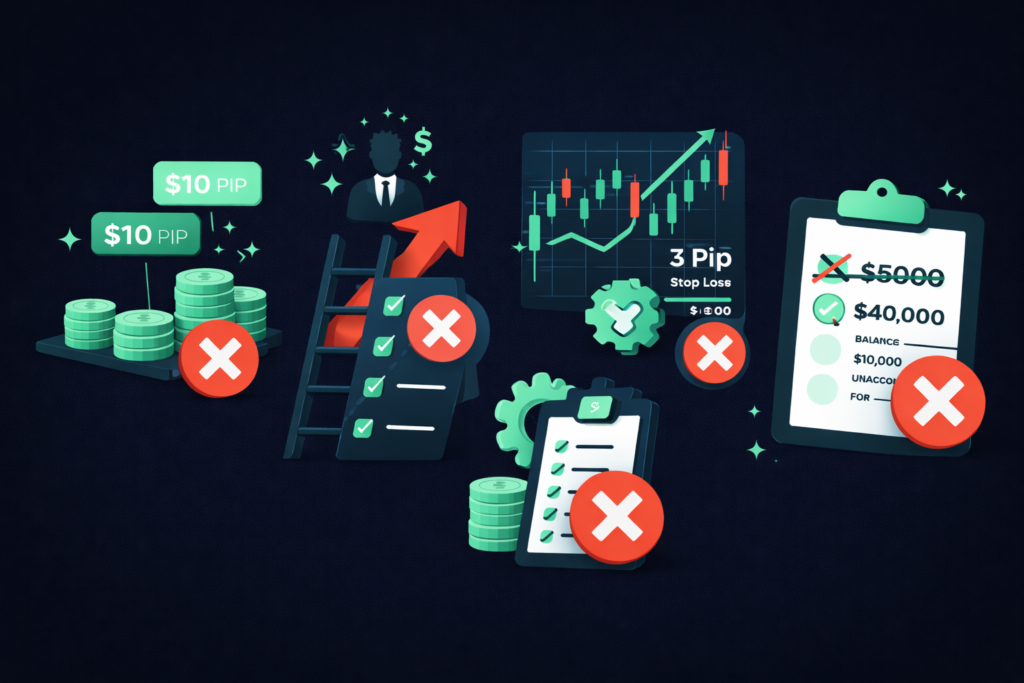
Ignoring Pip Value Differences Across Instruments
Traders get comfortable calculating position sizes for EUR/USD, then switch to GBP/JPY and use the same pip value. Wrong. Each currency pair, index, and commodity has different pip values depending on:
- Quote currency
- Contract size
- Lot specifications
- Platform conventions
Fix: Always verify the pip value in your platform's contract specifications before using this calculator. Never assume it's the same as your last trade. Different prop trading firms may use different platform providers with varying pip value conventions.
Scaling Position Size Based on Confidence
You hit three winners in a row on EUR/USD setups, so you decide to risk 3% instead of 1% on the next "high-probability" trade. This is exactly how consistent traders turn into former funded traders. Your confidence has zero correlation with market behavior.
Fix: Set a maximum risk per trade (1-2% is standard) and never exceed it, regardless of how good a setup looks. Risk management isn't flexible; it's the constant that keeps you funded.
Forgetting About Spread and Slippage
You calculate position size for a 20-pip stop loss, but during execution, the spread is 2 pip,s and you experience 1 pip of slippage. Your effective stop is now 23 pips, meaning you're risking 15% more than calculated.
Fix: Add a 2-3 pip buffer to your stop loss distance when using this calculator, especially if you trade during news events or low liquidity periods. Better to slightly undersize than blow past your risk limit.
Not Recalculating After Partial Profits
You take partial profits on a position and move your stop to breakeven. Instead of recalculating position size for your next trade based on your new account balance, you use the same lot size as before. If you took profits, your account grew; your position sizes should grow proportionally.
Fix: Recalculate position size after significant account changes. If your balance increases by 10%, your lot sizes should increase by approximately 10% to maintain a consistent percentage risk.
Using the Wrong Account Balance
Some traders input their starting balance instead of their current equity. Others use their balance but forget they have open positions that affect available capital. Both create inaccurate position size calculations.
Fix: Use your current equity (balance + floating P/L) when calculating position sizes for new trades. This gives you the most accurate representation of what you can actually risk.
Position Sizing for Different Trading Strategies
Your position size calculation doesn't change, but your risk parameters should adapt based on your trading style and prop firm structure:
Scalping and Day Trading
For high-frequency traders taking 5-10 trades per day:
- Risk per trade: 0.5-1% maximum
- Why: Multiple trades mean multiple opportunities for losses to stack
- Calculation focus: Keep stop losses tight (5-15 pips) and position sizes smaller
- Platform consideration: Factor in commission costs; they add up quickly on high-frequency trading
- Mental edge: Trading psychology becomes critical when taking multiple positions daily
Swing Trading
For traders holding positions overnight or across multiple days:
- Risk per trade: 1-2% maximum
- Why: Wider stops and overnight gaps require more buffer room
- Calculation focus: Account for weekend gaps by adding a 10-20% buffer to stop distance
- Program fit: Works well with Pulse Flex since overnight holding is allowed
News Trading
For traders specifically targeting high-impact economic releases:
- Risk per trade: 0.5-1% (never higher)
- Why: Volatility can spike 200-300% in seconds, triggering stops faster than expected
- Calculation focus: Double your estimated stop loss distance to account for spike potential
- Platform consideration: Slippage can be extreme—budget for 5-10 pip slippage minimum
Multi-Position Management
When running 2-3 positions simultaneously across different pairs:
- Risk per trade: 0.5-0.75% maximum per position
- Why: Correlated pairs can move together, multiplying your actual risk exposure
- Calculation focus: Total combined risk should never exceed 2% of the account
- Correlation check: Avoid taking long EUR/USD and short USD/JPY simultaneously, they're inversely correlated
Regardless of your strategy, the core principle remains: calculate first, trade second. Use this calculator before every single entry to ensure your position size matches your actual risk tolerance and prop firm limits.
When Position Sizing Becomes Critical for Prop Firm Success
There are specific scenarios where precise position sizing becomes the difference between staying funded and losing your account. Pay extra attention during these situations:
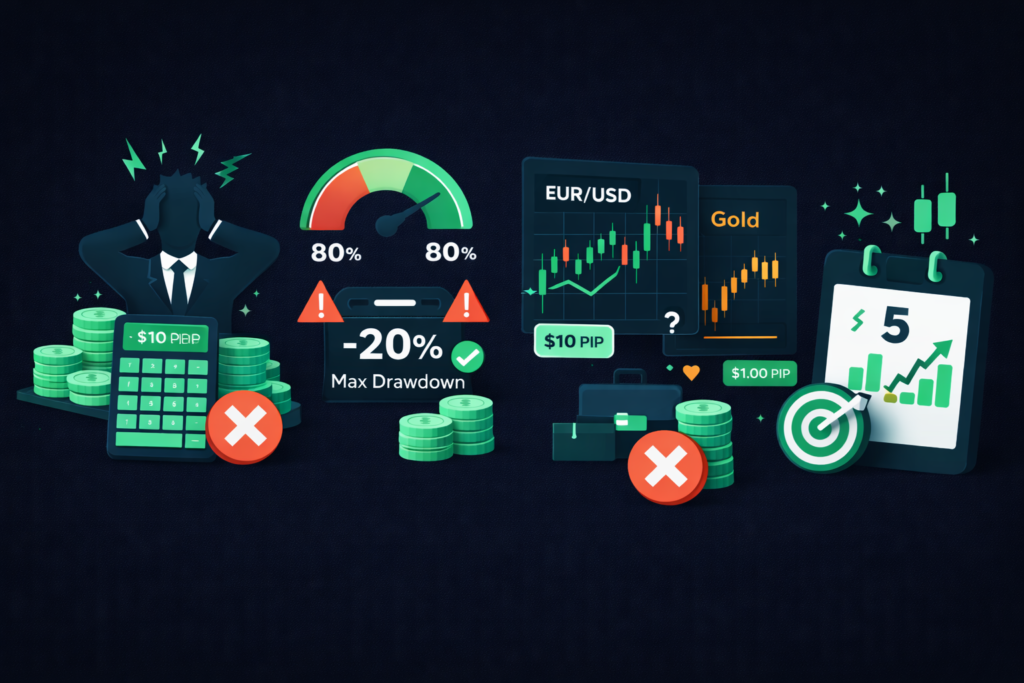
First Trade After a Loss:
This is when emotional trading typically begins. You want to "make it back" and unconsciously increase position size. Use the calculator to confirm you're still within your risk parameters; don't trust your judgment when emotions are involved.
Approaching Drawdown Limits:
If you're within 20% of your maximum drawdown, reduce position sizes by 30-50%. Your primary goal shifts from profit to preservation.
Smaller positions equal more margin for error. Understanding your timeline for getting funded helps you avoid rushing trades when close to limits.
Trading New Instruments:
Switching from forex to indices, or from EUR/USD to exotic pairs, changes everything about pip values and volatility. Recalculate position sizes from scratch; never copy-paste lot sizes across different instruments.
High-Impact News Events:
If you're trading through NFP, FOMC, or CPI releases, your normal 20-pip stop might not protect you. Double your stop distance in the calculator to account for volatility spikes, which automatically reduces your position size.
After Consecutive Wins:
Three green days in a row don't mean you should risk more. If anything, it's time to be more conservative; statistical regression suggests a losing trade is coming. Keep position sizes consistent regardless of recent performance. Trading efficiently means maintaining discipline even during winning streaks.
Turn Every Trade Into A Calculated Decision, Not A Guess
Funded trading rewards discipline, not confidence.
Every blown account traces back to one mistake: risking the wrong size at the wrong time. This calculator removes guesswork by turning your risk per trade into exact, rule-safe lot sizes in seconds.
Use it before every entry, after losses, during winning streaks, and when trading new instruments. When position sizing becomes automatic, emotions lose control, and consistency takes over.
Calculate first, trade second, and give yourself the statistical edge needed to stay funded and grow responsibly.
Our Latest Stories
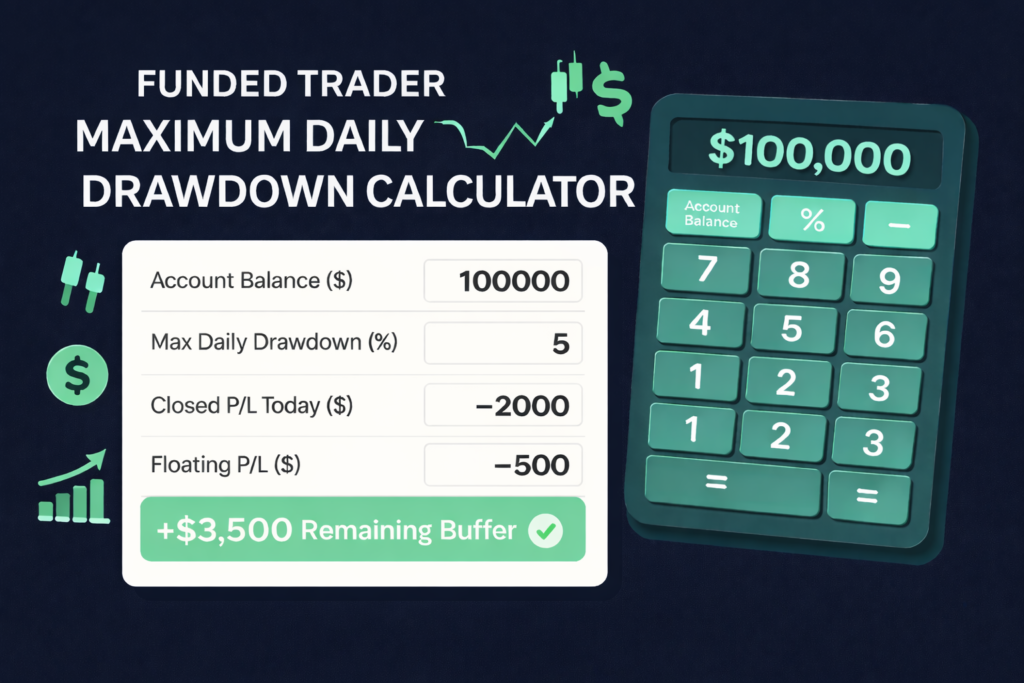
Funded Trader Maximum Daily Drawdown Calculator: Know Your Breach Point Before the Market Tests You
Managing your daily drawdown is the difference between staying funded and losing…


How To Get A Funded Gold Trading Account: A Clear Path for Trading Gold Without Personal Capital
Gold is one of the most actively traded assets in the world,…
When Does the Daily Loss Limit Reset in Prop Firm Accounts: Exact Reset Times Traders Must Know
Many prop traders follow every rule yet still lose accounts due to…
Stay Informed,
Stay Ahead
Bookmark this blog to keep your edge sharp. Whether you're prepping for your first challenge or scaling into a six-figure funded account, our insights are here to help.