
How to Choose the Right Prop Trading Firm: Expert Insights to Protect Your Capital and Sanity

The prop trading industry looks exciting at first glance, but choosing the right firm requires more than comparing prices and profit splits. Some firms thrive on transparency and structure, while others quietly rely on rules most traders never think to check.
Before you commit to any evaluation, this guide on choosing the right prop trading firm gives you a clear, practical way to separate stable opportunities from costly distractions.
Selecting a Prop Firm: Your 10-Step Evaluation Blueprint
Choosing the right firm requires examining trading style compatibility, risk parameters, payout reliability, and growth potential. The beauty of prop trading lies in its accessibility; you don’t need substantial personal capital.
Follow these ten steps to find a firm whose rules align with how you actually trade.
Step 1: Identify Your Trading Style and Required Rules
Your trading style dictates which firms can support your strategy and which will create constant friction.
Define these critical aspects:
- Trading style classification (scalper, day trader, swing trader, algo trader)
- Weekend holding requirements
- News trading frequency and timing needs
- Spread sensitivity and execution speed requirements
- Trade frequency (high-frequency vs low-frequency)
Pro Tip: Create a “non-negotiables” list with your three essential requirements. If you’re a swing trader, weekend holding permissions become mandatory.
Step 2: Select the Evaluation Model that Matches Your Personality

Different evaluation structures suit different trader personalities. When researching proprietary trading firms, you’ll encounter various funding models.
Match your profile to the right challenge:
- One-phase challenges suit confident, consistent traders
- Two-phase challenges work for structured, patient traders
- Instant funded accounts benefit traders wanting immediate market access
- Small-fee challenges help beginners build skills
Conservative traders often perform better with two-phase models offering more forgiving requirements, while experienced traders may prefer one-phase challenges.
Step 3: Compare Risk Parameters (This Decides 80% of Your Success)
Risk parameters determine whether your natural trading approach fits within a firm’s constraints.
Analyze these critical factors:
- Daily drawdown limits and reset timing
- Overall drawdown limits (trailing vs static)
- Profit targets in percentage and dollar terms
- Minimum trading days required
- Maximum lot size restrictions
- EA/algorithm permissions
Firms requiring 10% profits with 5% maximum drawdown create 2:1 success ratios, significantly harder than 8% targets with 10% drawdown allowances.
Reality Check: If your average winning day produces 2% gains, a firm with 3% daily drawdown limits forces complete position sizing restructuring.
Step 4: Evaluate the Firm’s Fee Structure and Refund Policy
Understanding total costs prevents surprises. Some firms offer instant funded trading accounts that eliminate evaluation phases but charge higher upfront fees, while traditional challenge models spread costs across attempts.
Examine these fee components:
- Initial challenge fees across account sizes
- Reset fees after failures (typically 20-40% discounts)
- Free retake policies
- Refund timing (immediate vs after first payout)
- Hidden costs in spreads or commissions
Most traders pass within 2-4 attempts, so a $500 challenge really costs $1,000-$2,000 when planning conservatively.
Step 5: Verify Payout Systems and Proof of Consistency
Reliable payouts matter more than generous profit splits that never materialize.
Research these payout indicators:
- Real payout proof from multiple traders
- Payment frequency and processing times
- Community discussions about delays
- Payment method reliability (crypto vs bank)
- Withdrawal thresholds
Search “[firm name] payout” in Reddit and forums for unfiltered experiences. Look for patterns rather than isolated incidents.
Step 6: Assess Broker Quality and Trading Conditions
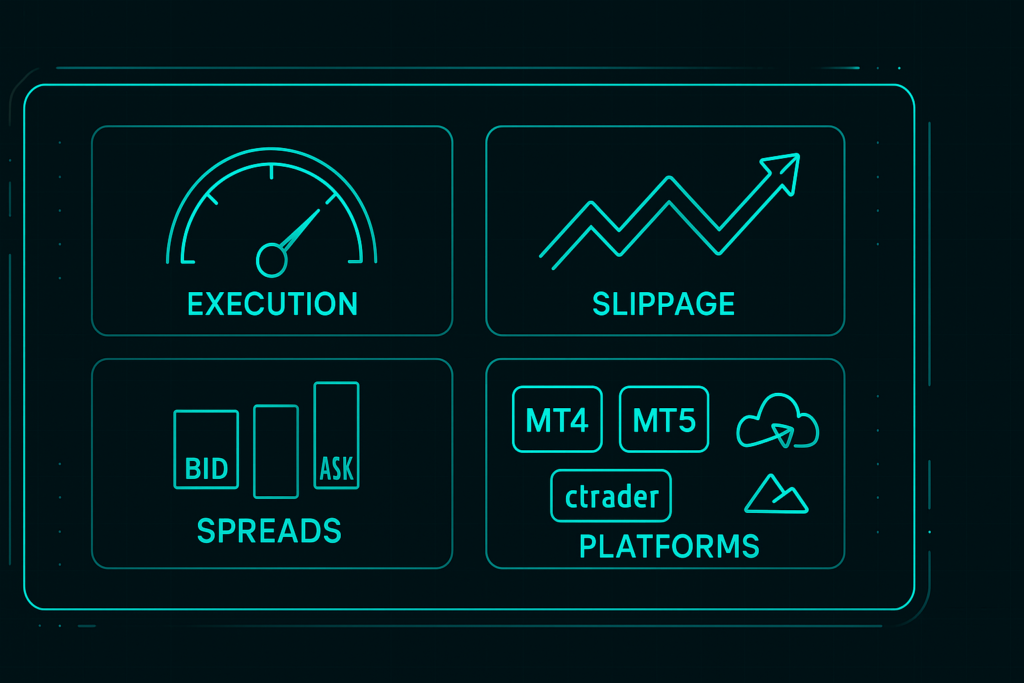
Trading infrastructure directly impacts execution quality and strategy viability.
Evaluate these technical factors:
- Average execution speeds during major market hours
- Slippage levels during high volatility
- Spread consistency (normal vs news periods)
- Platform availability (MT4/MT5, cTrader, TradingView)
- Server reliability during major releases
Test demo accounts during volatile periods. Acceptable markups add 0.2-0.5 pips on EUR/USD; excessive markups exceed 1.0 pip. Quality execution matters more for scalpers.
Step 7: Review Scaling Plans for Long-Term Growth
Scaling opportunities determine your income ceiling and career progression potential.
Investigate these growth factors:
- Capital scaling speed (quarterly, biannually, annually)
- Requirements for scaling (profit percentages, consistency metrics)
- Maximum capital offered (does it cap at $200K or extend to $500K+?)
- Whether scaling is automatic or requires applications
A firm offering three simultaneous $100K accounts with 80% profit splits and 5% monthly returns yields $12,000 monthly income potential.
Step 8: Check Transparency, Rulebook Clarity, and Firm Reputation
Operational transparency indicates whether a firm prioritizes trader success or fee collection.
Look for these transparency indicators:
- Public founders or verifiable leadership
- Detailed PDF rulebooks with specific definitions
- Trustpilot review patterns (genuine vs bot-generated)
- Active communities (Discord/Telegram with 1,000+ members)
- Documented support response times
Vague rules like “no excessive risk” without specific definitions create arbitrary enforcement opportunities. Quality firms define everything precisely.
Step 9: Align With a Firm Supporting Trader Development
Educational resources and community support accelerate skill development and problem-solving.
Evaluate these developmental factors:
- Educational content quality (strategy breakdowns, not motivational content)
- Risk management tools and calculators
- Webinar frequency and mentorship availability
- Active trader community
- 24/7 support for clarifications
Firms invested in trader success provide substantial educational resources beyond basic tutorials, including position sizing formulas and drawdown recovery strategies.
Step 10: Run a “Legitimacy Test” Before Purchasing
Final verification prevents investing in firms with problematic operations or questionable longevity.
Complete these final checks:
- Verify long-term payout history (12+ months)
- Confirm rules haven’t changed frequently
- Validate trading conditions match industry standards
- Ensure no aggressive upsells or unrealistic promises
- Test customer support responsiveness
Search the firm’s name with “scam,” “review,” and “complaint” to identify patterns. Join their community channels and observe how they handle difficult questions.
Implementation Checklist: Only proceed after confirming verifiable payout history, reading the complete terms, and receiving satisfactory answers to all rule clarification questions.
This systematic evaluation protects you from costly mistakes: incompatible firms, payout issues, and evaluations designed for failure rather than success.
Prop Firm Selection Mistakes: 6 Costly Errors to Avoid
Even experienced traders make critical selection mistakes that cost them time, money, and confidence. Understanding these common pitfalls helps you avoid expensive learning experiences and choose firms that genuinely support your success.
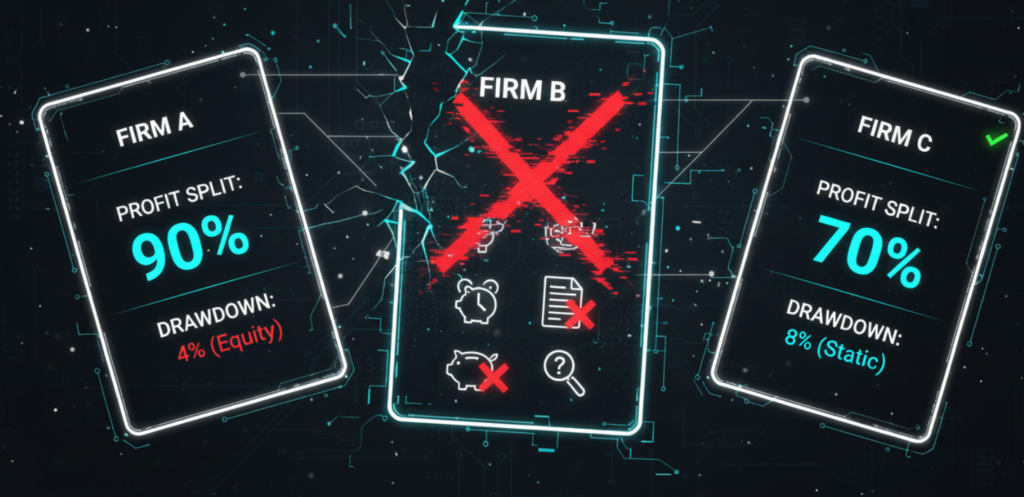
Choosing Based Solely on Profit Split Percentages
The most common mistake is selecting firms advertising 90% or 95% profit splits without examining other terms. A firm offering 90% splits but requiring 15% profit targets with 4% maximum drawdown creates nearly impossible conditions.
What you should do instead:
- Calculate the complete evaluation difficulty, not just the profit split
- Compare profit targets relative to drawdown limits (look for 1:2 ratios or better)
- Examine payout frequency, withdrawal minimums, and scaling opportunities
- Remember that profit splits mean nothing if you can’t pass evaluations
Ignoring Drawdown Calculation Methods
Traders frequently overlook whether firms use static or trailing drawdown calculations. Static drawdowns remain fixed from your starting balance, while trailing drawdowns move with your high-water mark.
Even more critical is understanding balance-based versus equity-based calculations.
Ask these questions before committing:
- “Do you use static or trailing drawdown calculations?”
- “Is drawdown calculated on balance or equity?”
- Understand that equity-based drawdown is significantly stricter than balance-based
- Test scenarios with your typical position sizes against their limits
Falling for Aggressive Marketing and Discount Pressure
Limited-time discounts, countdown timers, and “only 3 spots remaining” tactics pressure traders into hasty decisions without proper research.
Take control of your decision timeline:
- Allow at least 3-5 days to research before purchasing any challenge
- Compare at least 3-4 firms before making your decision
- Remember that quality firms offer transparent, consistent pricing
- If a promotion expires, evaluate whether the terms genuinely suit your needs
Not Reading Complete Terms and Conditions
Many traders purchase challenges based on marketing materials without reading the complete rule documents. Hidden requirements around consistency rules, maximum position sizes, or prohibited strategies often cause unexpected evaluation failures.
Protect yourself with thorough research:
- Download and read the complete terms and conditions PDF before purchasing
- Search documents for terms like “consistency,” “maximum position,” and “prohibited strategies.”
- Ask support directly about any unclear or ambiguous rules
- Screenshot all rules before purchasing as evidence
Selecting the Largest Account Size Without Experience
New prop traders often purchase $100K or $200K challenges, believing larger accounts accelerate earnings.
In reality, larger accounts increase psychological pressure and may come with stricter requirements.
Start smart with a strategic approach:
- Begin with smaller accounts ($10K-$25K) to learn firm-specific rules
- Use initial challenges to understand platform behavior and evaluation strategies
- Scale up only after successfully maintaining smaller funded accounts
- Calculate that passing smaller challenges costs less than failing multiple large attempts
Skipping Platform Testing and Demo Access
Traders sometimes purchase challenges without testing the trading platform during their actual trading hours or market conditions.
Validate platform quality first:
- Request demo access and test during your actual trading hours
- Execute trades during volatile periods to check execution speed
- Verify that spreads remain consistent during high-impact news releases
- Confirm the platform supports your preferred trading tools and indicators
By avoiding these six mistakes, you position yourself to select a prop firm with transparent rules, fair evaluation structures, and genuine trader support that aligns with your goals and trading style.
Prop Trading Reality Check: Is This Path Right for You?
Before investing time and money researching prop firms, determine whether prop trading actually aligns with your current situation, skills, and goals. This honest assessment prevents costly mistakes and wasted effort.

When Prop Trading Makes Perfect Sense
Prop firms offer genuine opportunities for traders in specific situations where the model provides clear advantages over alternatives.
You’re an ideal candidate if you:
- Have limited personal capital but proven trading skills and a consistent strategy
- Demonstrate discipline with risk management and can follow structured rules
- Want to trade larger capital without risking your savings or emergency funds
- Seek accountability and structure that the evaluation challenges provide
- Can afford challenge fees without financial strain (typically $50-$500)
- Have at least 6-12 months of profitable demo or small-account trading history
- Understand that prop trading requires passing evaluations before accessing capital
Prop firms shine for skilled traders who’ve proven profitability on smaller accounts but lack the capital to scale their income meaningfully. If you consistently generate 3-5% monthly returns on a $5K account, prop firms let you apply those skills to $50K-$200K capital.
When Prop Trading Becomes a Bad Idea
Prop trading isn’t suitable for everyone, and entering too early often leads to repeated failures and financial losses.
Avoid prop firms if you:
- Lack a tested and profitable trading strategy with documented results
- Approach trading with a gambling mindset, seeking quick wins
- Cannot afford to lose challenge fees without affecting essential expenses
- Trade emotionally or struggle with consistent risk management
- Have significant debt or financial obligations requiring a stable income
- Expect immediate profits or view prop firms as “get rich quick” schemes
- Cannot commit time to properly study firm rules and evaluation requirements
The challenge fee model means you’ll likely spend $500-$2,000 across multiple attempts before funding. If this creates financial stress, focus on building skills and capital with personal accounts first.
Quick Self-Assessment: Are You Ready?
Answer these questions honestly to determine your readiness for prop trading.
You’re NOT ready for a prop firm if:
- Your personal trading account isn’t consistently profitable over 6+ months
- You can’t explain your trading strategy’s edge in specific terms
- You violate your own risk management rules regularly
- Challenge fees represent more than 5% of your liquid savings
- You’re using borrowed money or credit to pay for evaluations
- Your current financial situation requires immediate trading income
- You haven’t practiced trading with evaluation-style restrictions (drawdown limits, profit targets)
You ARE ready when:
- You’ve maintained positive returns for at least 6 consecutive months
- Your risk-per-trade never exceeds your predetermined maximum
- You understand and accept that funding takes 2-4 evaluation attempts, typically
- Challenge fees come from disposable income, not essential funds
- You can commit 10-15 hours weekly to trading and evaluation
- You’ve studied specific firm rules and confirmed strategy compatibility
The Honest Alternative Path
If you’re not ready for prop firms yet, focus on these development steps:
Build skills first through demo trading and small personal accounts ($500-$2,000). Master risk management and develop consistency before attempting evaluations. Many successful prop traders spent 1-2 years building skills before pursuing funding.
Consider copy trading or signal services only after verifying track records independently. These rarely substitute for developing your own skills, but can provide learning opportunities.
Growing personal capital through disciplined trading builds both skills and confidence. Once you demonstrate consistent profitability over 6-12 months, prop firms become a logical next step for scaling.
Prop trading works brilliantly for prepared traders but punishes those who enter prematurely. Be honest about your current position, and choose the path that genuinely serves your development.
Turning Your Prop Firm Research Into A Smart Funding Choice
Choosing the right prop firm becomes far easier when you evaluate rules, risk parameters, payout reliability, platform quality, transparency, and long-term growth opportunities with intention rather than emotion.
By applying this structured process, you can confidently eliminate unstable firms and focus on those that genuinely support disciplined, skill-based traders. After that, it’s as simple as patiently waiting to get your funded account approved, and the sky becomes the limit after that.
Your research now becomes a strategic filter, one that protects your capital, your trading mindset, and your path to sustainable funded trading.
Our Latest Stories
How to Get a Funded Forex Trading Account: Expert-Level Strategies for Realistic, Repeatable Success
The funded trading world is growing so fast that some firms now…

How Long Does It Take to Get a Funded Account: Timelines Explained for Every Trader Type
The journey to becoming a funded trader rarely unfolds the way people…

Stay Informed,
Stay Ahead
Bookmark this blog to keep your edge sharp. Whether you're prepping for your first challenge or scaling into a six-figure funded account, our insights are here to help.